
How Mega SEO Customizes Blog Content to Your Business
Experts lead. Agents execute. Humans stay accountable.
Mega SEO offers automated SEO & Marketing for startups. The SEO Agent writes blog content the same way an experienced strategist would: starting from your business’s own data, in depth research, customized prompts rather than the generic prompts, using specialized agents for research, structure, SEO, AEO and GEO rules, with a person signing off before anything goes live. Humans direct the AI to conduct research, and craft articles that bring value to your business and search engine. Customization means there should be a different set of rules, goals, demand and work that align to your goal, business needs, topics and best SEO practices.
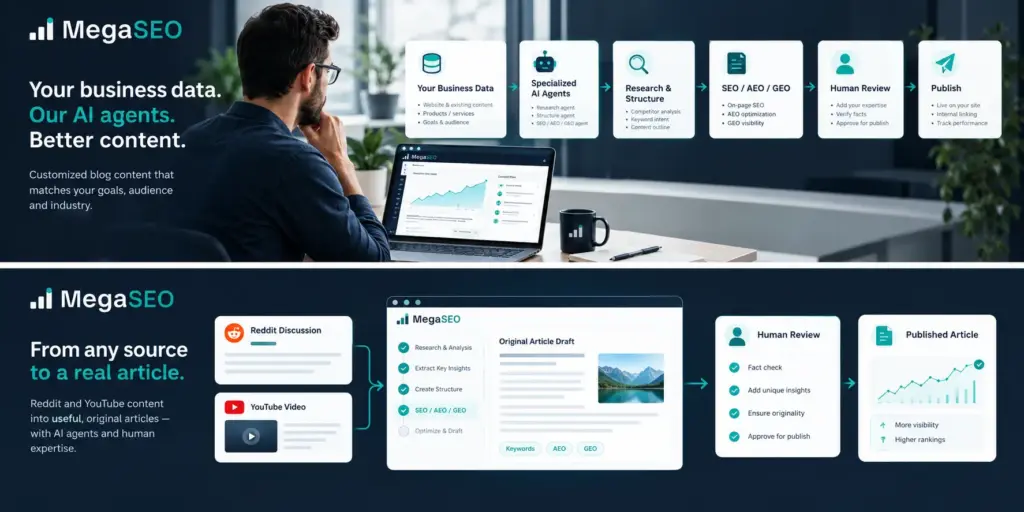
Mega SEO also turns raw material you already have into a real article. Reddit to Blog Post takes a thread and builds a post around it. YouTube to Blog Post does the same from a video. In both cases, an AI agent reads what’s actually there, works out what’s worth keeping, and writes it up as something a reader can use, not just a summary of what was said. Book a demo to see the same agents work on your own site.
A blog that goes quiet for two months looks abandoned, to readers and to Google. But the bigger risk usually isn’t the gap between posts. It’s the articles already sitting on your site, published a year ago, slipping in rankings while nobody’s looked at them since. The SEO Agent audits what’s already there and refreshes the pages that have stalled, not just the pages that don’t exist yet.
How the customization actually works
Three things happen together, and none of them do much on their own.
Your own data as the input. The agent starts from your site’s existing pages, your products, and your stated goals, not a blank prompt with a keyword typed into it. A draft built this way already has somewhere to point: your other pages, your own terminology, the gaps in what you’ve already published.
Specialized agents instead of one model doing everything. Research, structure, keyword strategy, and SEO rules are handled as separate stages, each with its own standard to meet before the next stage picks it up. Keyword targets come from competitor analysis and actual search intent, not a generic keyword tool. A single model asked to research, write, and optimize all at once has to trade those goals off against each other; splitting the work means nothing gets compromised to make room for something else.
Rules that change with the business, not just the topic. The SEO, AEO, and GEO mix isn’t one-size-fits-all. A local service business gets most of its buying traffic straight from Google, so its plan leans on SEO. A B2B SaaS company’s buyers research on Google and inside tools like ChatGPT and Perplexity, so its plan needs SEO, AEO, and GEO working together. A publisher’s whole point is getting cited by AI answers, so its plan leans on AEO. The Agent applies the mix that fits the business, instead of one ratio for every client.
A person signs off before anything publishes. Every draft still needs someone to add what only they know, check the facts, and decide it’s worth their name. That step doesn’t go away because the drafting got faster. See pricing for what that looks like as a plan, or book a demo to watch it run on your own site.
The other risk: content that’s already published
A blog that goes quiet for two months looks abandoned, to readers and to Google. But the bigger risk usually isn’t the gap between posts. It’s the articles already sitting on your site, published a year ago, slipping in rankings while nobody’s looked at them since. The SEO Agent audits what’s already there and refreshes the pages that have stalled, not just the pages that don’t exist yet.
One thing about Reddit content that most guides skip
Reddit’s terms restrict commercial use of its content outside fair use, and Reddit has gone to court over it. It sued Anthropic in June 2025 and Perplexity in October 2025, both over commercial use of Reddit content without a licensing deal, and both cases were still open as of this writing. Reddit has separate paid licensing arrangements with Google and OpenAI.
That doesn’t mean you can’t draw on Reddit for ideas. It means quoting a thread at length and republishing it as your own content is a different thing than reading a thread, writing your own post about what it covers, and linking back to where it came from. Reddit to Blog Post does the second one. If you’re building anything similar yourself, that distinction is worth knowing before you build it, not after.
Can AI-written blog posts rank on Google in 2026?
Yes, when they add something a generic draft wouldn’t. Google’s scaled content abuse policy targets pages made mainly to manipulate rankings, whatever tool produced them, not AI use on its own.
Google’s own guidance on generative AI content says AI can help with researching a topic and adding structure to original work, and that telling readers how a piece was made gives them useful context.
The data backs this up, with a catch. A June 2026 Ahrefs study of 1 million pages across 100,000 search results found 54.7% of top-10 pages had under 20% detected AI content, and pages under 50% AI content made up 82.2% of top-3 rankings. Fully AI-generated pages can still crack the top 3. They’re just a small slice of that group, and AI detection itself is far from exact, so read this as a strong pattern, not a rule.
This is the actual reason the SEO Agent starts every draft from your own business data instead of a blank prompt: a draft built around your real keywords, your competitors, and your existing pages starts a lot closer to “adds value” than one built from nothing.
What should you check before you publish a draft?
Is it safe to build your whole blog with AI?
Not on its own, no. It works as one part of a plan, and the part it’s good at is structure and a first pass. The part it’s bad at is everything that makes a post yours: opinion, first-hand experience, proof.
That split is basically the whole idea behind Mega SEO: experts set the direction, the agents do the drafting, and a person stays accountable for what actually publishes. Most competing AI writers skip straight from prompt to finished article with no site context and no review step built in. Skipping that step is how you end up with a blog that reads like everyone else’s.
A quick example of what “human-reviewed” actually looks like
Before a draft from the SEO Agent goes live, a strategist reads it the way they’d read a new hire’s first draft: checking whether the keyword it targets is one they’d actually recommend for that client, cutting any claim that doesn’t hold up on its own, and adding at least one thing the draft couldn’t have known on its own, a client result, a local detail, something from a conversation with that kind of business before. If nothing in it required a human judgment call, it doesn’t go out yet.
Frequently asked questions
Clear Answers To Common Questions
Everything you need to know about our AI agents, senior strategist oversight, customization and operating model
Where to go next
Want a quick, free look first? Run Reddit to Blog Post or YouTube to Blog Post on something in your niche.
Want the full version, built from your own business? See pricing or book a demo to watch the SEO Agent run on your own site.